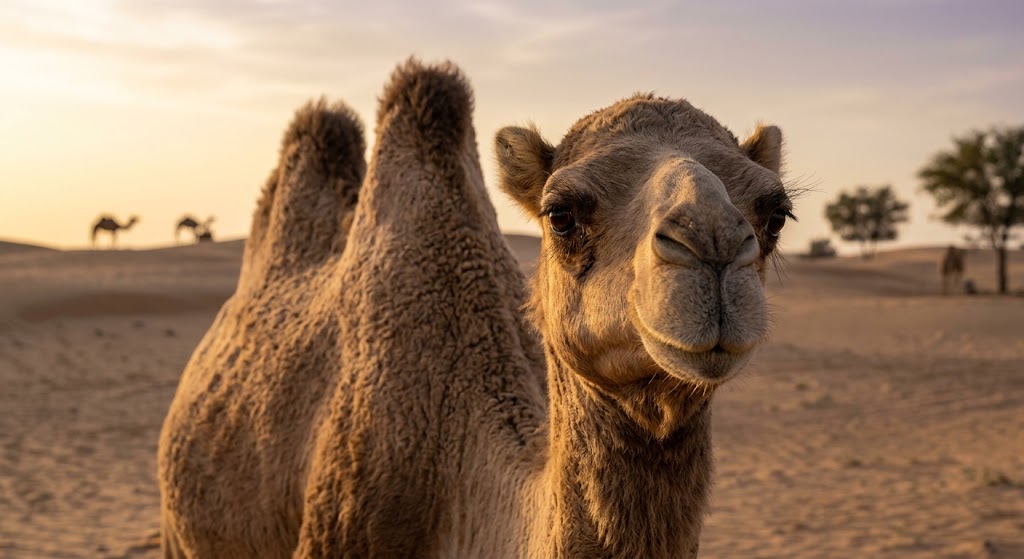
The ancestors of our domestic camels – the wild camels are already threatened with extinction. Remaining populations of around 600 – 900 animals are primarily only found in Mongolia. There the animals managed to survive in a habitat that is characterized, for example, by extreme temperature differences. The largest habitat for the last remaining wild camels is the Gobi National Park.
Classification according to biological systematics
Camels belong to the artiodactyls and are the only animal species to form the suborder of callous-soled animals. The camels’ feet are something very special. On the one hand, they have a very pronounced third and fourth toe. On the other hand, the sole of the foot consists of thick and resilient connective tissue. Camels also have two nails and not hooves like other artiodactyls.
The camel family can be found in Old World camelids and in New World camelids differentiate. The Old World camels include dromedaries and Bactrian camels, the latter of which are also called Bactrian camels. Again and again you start to wonder whether the dromedary has one or two humps and how many humps the Bactrian camel has. The easiest way to remember it is to turn the first letters “D” and “B” onto the long side. The “D” has only one belly, which is why dromedaries have only one hump, the “B” has two bellies, which is why the Bactrian camel or Bactrian camel has two humps.
The New World camelids can be divided into llamas, alpacas, and the wild forms vicuñas and guanacos.
Camels as survivors in extreme habitats
Camels are true survivors if you consider their demands on their habitat, which are not particularly high.
Dealing with temperature fluctuations
Camels have adapted perfectly to extreme living conditions. On the one hand, large temperature fluctuations are not a problem for camels. In their natural habitat, the ancestors of our domestic camels are sometimes exposed to fluctuations of 50° Celsius. How can camels deal with this? The organism is adapted so that the animals absorb heat during the day and the body temperature rises up to 41 ° Celsius. At night the animals then give off this heat again and the body temperature drops to up to 34 °Celsius. By reaching this low temperature, warming up the next day also takes longer. The release of temperature is also made possible by the lack of an isolated layer of fat on the legs and body, as the fat reserves are only located in the hump, even though there is a persistent rumor that water is stored there.
Camels’ handling of liquids
Camels use liquid very sparingly. The animals’ droppings are extremely dry, so they can be used very well as fuel. Camels also manage to extract moisture from the air when they breathe. Camels can also cope well with a fluid loss of up to 30 percent. In humans, on the other hand, a loss of around 10 percent becomes critical.
The animals’ urine is very concentrated, so that only small amounts have to be excreted. What is particularly fascinating, however, is that camels are the only mammals to have oval blood cells. This allows them to absorb up to 150 liters of water within 15 minutes after a long period of time without liquid.
Outlook: There are now people in Germany who can no longer resist the fascination of camels and who have dedicated themselves to this animal species. If you are interested, camel owners will be happy to provide you with further information about camels. And for those who are brave, there will definitely be the opportunity to experience the world riding between two humps.